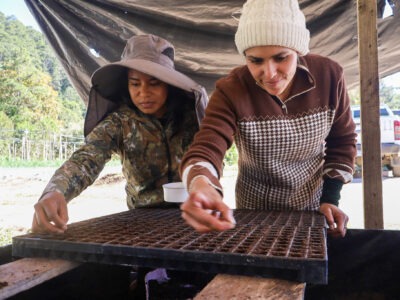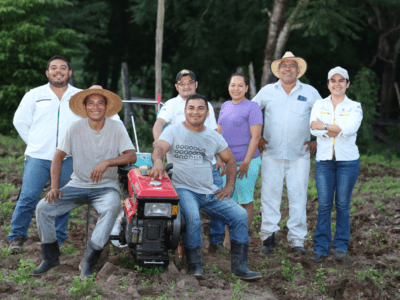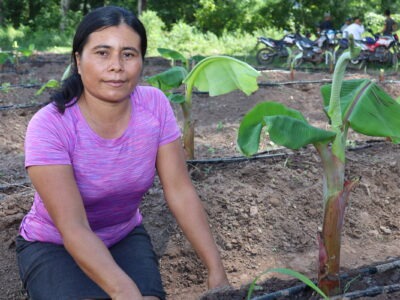

Honduran Women’s Day, celebrated on January 25, commemorates the political achievement of Honduran women earning the right to vote in 1955, a event that opened the door to their full participation in public life. Read the story below about how Honduran women are continuing to inspire through leadership and innovation.
In western Honduras, five entrepreneurial women transformed their vision of what agriculture could provide for themselves and their families. This is how their business, Sabores de Horcones (Flavors of Horcones), was born. What began as a simple business idea to add value to seeds and agricultural products bought by their neighbors and other local producers grew into an enterprise that today generates income, employment, and hope. Their business turns local products, such as plantains, cassava, and bananas, into artisanal chips that are now recognized in their community.

Early Success and Growing Pains
The road was not easy; they started with basic equipment and long working hours to fulfill orders. Stephanie, a local farmer, imagined a business based on the crops available to her and her neighbors. She teamed up with four other women entrepreneurs, who purchased their first basic processing equipment with funds from the Municipality of Jesús de Otoro and their own savings.

However, after winning over local palates with their artisanal chips, they struggled to meet demand. “Before, we couldn’t keep up,” Stephanie said. The real change came when the group partnered with the Integrated Rural Development and Productivity Project (SAG-ProOccidente). The project, sub-implemented by ACDI/VOCA, is a five-year initiative led by Honduras’s Secretariat of Agriculture and Livestock (SAG) and funded by the Inter-American Development Bank (IDB) and the Spanish Agency for International Development Cooperation (AECID).
Through SAG-ProOccidente, Stephanie and her business partners received comprehensive technical assistance. Together, they learned how to calculate costs, apply hygienic practices, and move toward legal formalization. In addition to training, SAG-ProOccidente provided funds for members to expand their physical space for production and procure modern, climate-smart equipment, allowing them to achieve more uniform and higher quality products.

Tripling Production with New Skills and Technology

“Thanks to these technologies, we went from processing 1,000 bananas per week to 3,500, tripling production and meeting demand without delays,” Stephanie said.
After much hard work, the entrepreneurs started earning higher incomes and carving a path toward stable livelihoods, a feat that many Hondurans living in rural areas struggle to achieve.
“Our dream is to establish ourselves as a microenterprise and reach bigger markets,” Stephanie said.
Creating Stable Livelihoods in Rural Honduras
Sabores de Horcones is more than a business; it’s an example of how innovation, teamwork, and technical support can transform communities. By facilitating access to basic income-management tools and resources, SAG-ProOccidente is helping entrepreneurs in rural Honduras eventually establish their own relationships with suppliers and the market. With every slice of a banana, these women entrepreneurs are building a more sustainable and inclusive future for themselves and their community.
About SAG-ProOccidente
SAG-ProOccidente works with multiple partners, including local producers, the private sector, indigenous organizations, and small and medium enterprises, to build sustainable economic and climate resilience and reduce migration out of the country, promoting self-reliance through local ownership.
SAG-ProOccidente provides technical assistance and training to more than 10,000 agriculture and livestock producers across six departments and 88 municipalities by helping them adopt new climate-smart technologies and practices and improving their access to finance.
Activities take place in the western departments of Santa Bárbara, Copán, Ocotepeque, Intibucá, Lempira, and La Paz, focusing on horticulture, fruit, coffee, cacao, dairy cattle, and those related to cultural products of ethnic origin.
The project is funded by the Inter-American Development Bank (IDB) and the Spanish Agency for International Development Cooperation (AECID) through the Fund for the Promotion of Development (FONPRODE).